

Linear lighting unit converter
Convert feet and metres, W/ft and W/m, or lm/ft and lm/m using the exact length factor. Keep measurement conditions visible when comparing source data.
Updated October 26, 2026
Discuss your requirementOn this page
Convert linear-lighting units before comparing quotations. A unit conversion changes the numerical basis; it does not make measurements from different test conditions or fixture boundaries comparable.
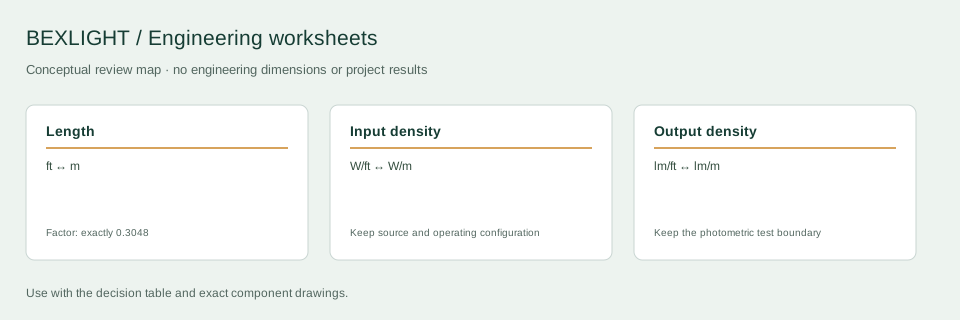
Decision and input record
| Decision | What to check | Record or boundary |
|---|---|---|
| Length | ft ↔ m | Factor: exactly 0.3048 |
| Input density | W/ft ↔ W/m | Keep source and operating configuration |
| Output density | lm/ft ↔ lm/m | Keep the photometric test boundary |
Length uses an exact definition
The international foot equals exactly 0.3048 metre. Metres = feet × 0.3048, and feet = metres / 0.3048. NIST documents this definition. Use consistent units for active strip length, reel quantity and finished assembly dimensions; those are different quantities even after the length units match.
Per-length quantities convert in the opposite direction
A value in W/ft becomes W/m by dividing by 0.3048. The same arithmetic applies to lm/ft and lm/m. Converting W/m to W/ft multiplies by 0.3048. As a hypothetical example, 3 W/ft equals approximately 9.8425 W/m; over 10 ft, both unit systems describe a total of 30 W at the original rating basis.
Keep the original source record
Retain the original value, unit, source model and data-sheet revision beside the converted value. Do not round converted values early and then multiply a long project quantity. The on-screen result is rounded for reading; the calculation uses the entered number and the exact conversion factor.
Do not convert away a scope difference
Lumens per metre from a bare source cannot be compared directly with finished-fixture lumens per metre without addressing the optical boundary. Watts at DC strip input are not measured AC system consumption. Two numbers with matching units can still answer different questions. Resolve those differences before ranking supplier offers.
What to include in a technical inquiry
Use the converter to normalize units, then record the remaining differences in test conditions and supply scope. Matching units is the start of a comparison, not its conclusion.
Discuss the application and supply scope
Continue with the relevant detail
Reference and scope
- NIST: international foot definition. Exact 0.3048 m conversion factor.
Tell us about your installation
Include the application, section lengths, quantity and installation conditions.
Discuss your requirement