
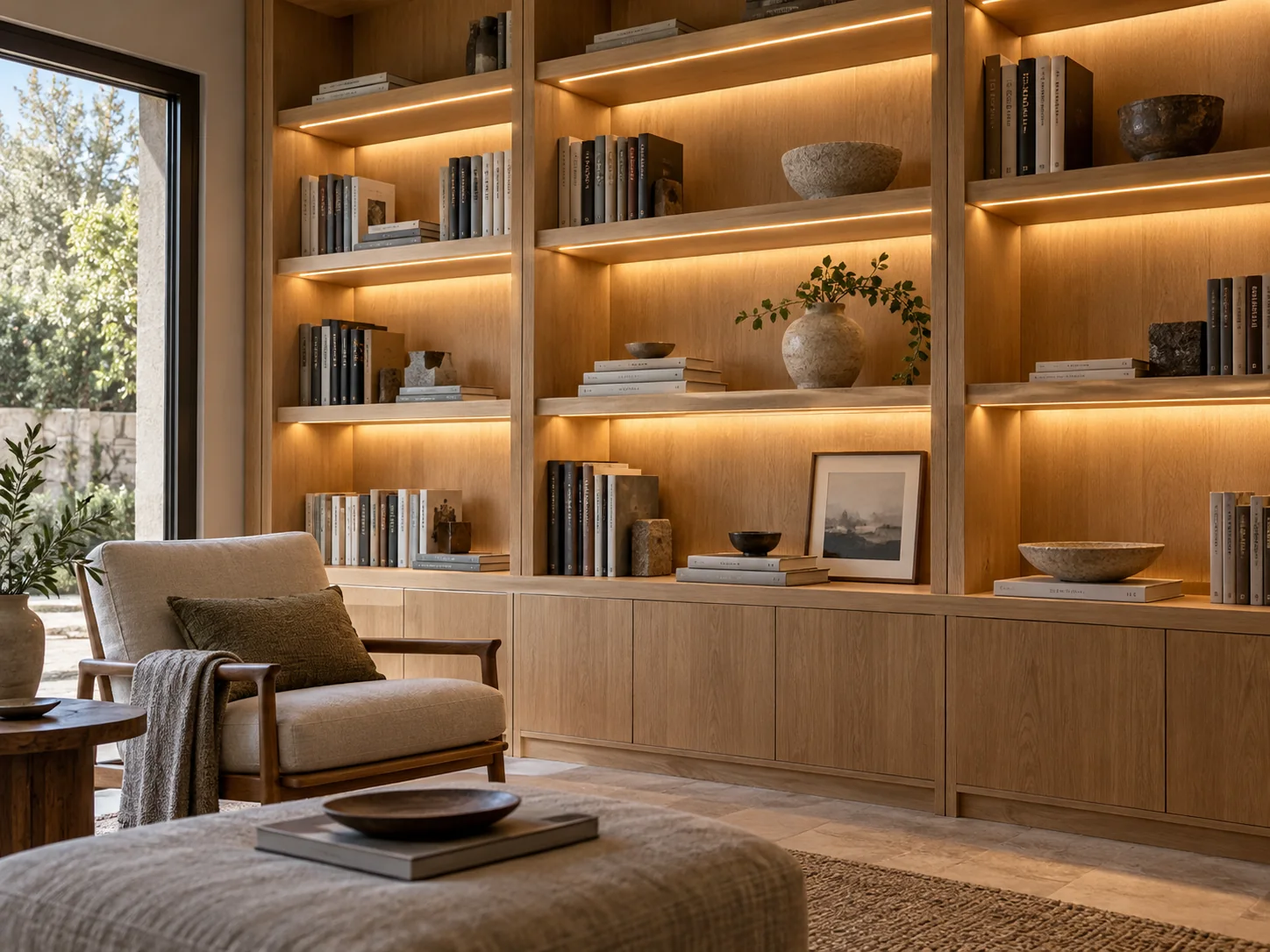
COB vs SMD for integrated lighting
Choose COB or SMD by testing the finished detail, not by treating either construction as a quality grade.
Updated 22 10 月, 2026
Discuss your requirementOn this page
Choose COB or SMD by testing the finished detail, not by treating either construction as a quality grade. The useful comparison is between identified models installed in the same profile, diffuser and viewing geometry.
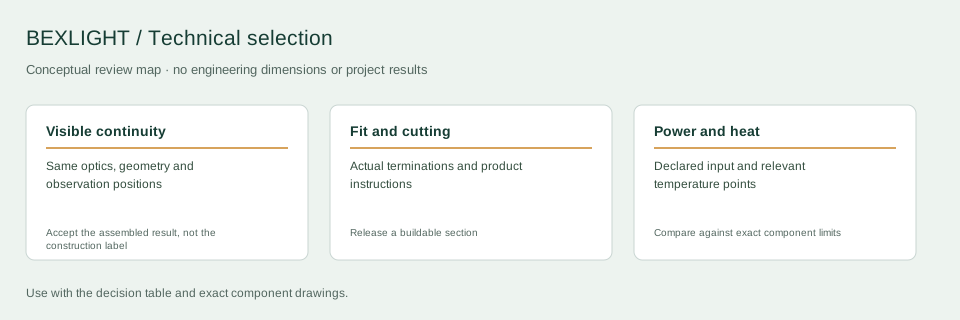
Decision and input record
| Decision | What to check | Record or boundary |
|---|---|---|
| Visible continuity | Same optics, geometry and observation positions | Accept the assembled result, not the construction label |
| Fit and cutting | Actual terminations and product instructions | Release a buildable section |
| Power and heat | Declared input and relevant temperature points | Compare against exact component limits |
Define the comparison boundary
A bare strip photograph answers a different question from a completed fixture. List the two source models, active lengths, declared voltage, mounting profile, diffuser and allowed operating scene. Record the actual sample input conditions. If the models have different input power or output, retain that difference in the record instead of calling the trial equivalent.
Test the visual requirement
For a visible line, inspect continuity from the agreed viewing distance and angles. For an indirect light, observe the receiving surface and any reflected image of the source. Use the actual joinery or fixture section. Do not assume the construction name alone predicts whether dots, shadows or a reflected bright line will be visible in a particular assembly.
Compare the installed configuration
Check the fit of the source and its terminations, permitted cutting pattern, mounting method and replacement path. Review exact-model photometric and temperature information. A narrower PCB or a shorter nominal cut interval can help one drawing and be irrelevant to another. Package density is not a substitute for the assembled thermal and optical checks.
Make the decision repeatable
Keep a comparison sheet with a pass, unresolved or fail entry for every requirement. Retain the chosen source, profile and diffuser identities on the drawing. If the rejected sample failed only because of an unsuitable profile position, record that reason; it does not establish that the construction is unsuitable for every project.
What should a B2B sample request contain?
Include the fixture cross-section, desired CCT, viewing task, candidate lengths and intended controller. Ask for model-specific data for each sample. State whether the trial concerns source continuity, work-surface coverage, colour presentation or another defined result. A sample order with a clear validation purpose is part of B2B development even when the quantity is small.
What to include in a technical inquiry
Send the section drawing and the result the fixture must achieve. The selection can then be compared against actual candidates without inventing a universal COB or SMD recommendation.
Discuss the application and supply scope
Continue with the relevant detail
- LED strip lighting for cabinet production
- LED strip lighting for retail fixtures
- LED strip quotation brief for B2B buyers
Reference and scope
- Waveform Lighting: example of model-specific photometric documentation. External example of report identity. Its measured values do not describe BEXLIGHT products.
Tell us about your installation
Include the application, section lengths, quantity and installation conditions.
Discuss your requirement