
Cabinet Lighting Sample Approval for Repeat Orders
Create a cabinet lighting sample approval record covering assembly identity, fixture fit, appearance, controls and changes before repeat orders.
Updated October 26, 2026
Discuss your requirementOn this page
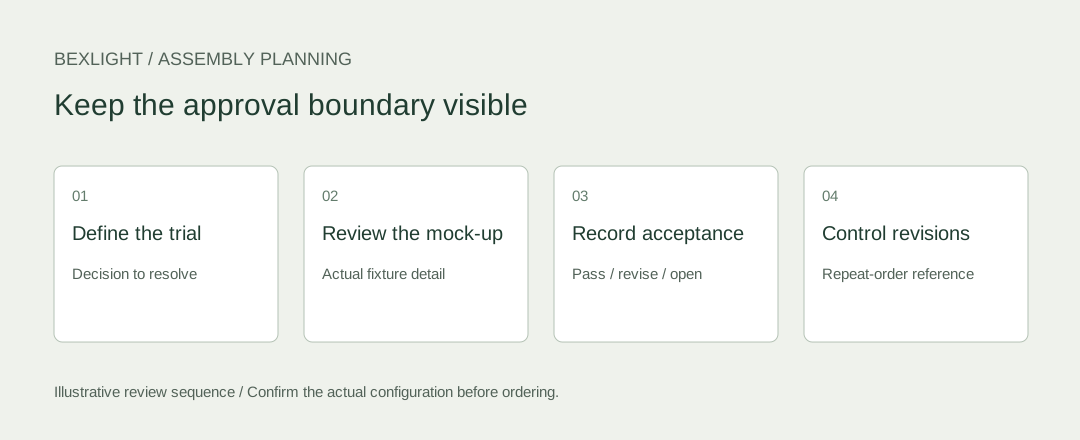
Approve a defined assembly, not a loose strip
A light source can look acceptable on a desk and reveal bright reflections once installed behind glass or next to a polished cabinet finish. A cabinet lighting sample approval should therefore name the furniture detail and the conditions under which the sample was reviewed. “Sample approved” alone does not tell the next purchasing team what must remain the same.
Use an assembly sample wherever the decision depends on the profile, diffuser, cable outlet or sensor position. A bare source is suitable for a source-level question, but it cannot approve the mechanical fit of a complete furniture module.
Make a sample request that can be answered
Send the current fixture section, requested CCT, normal viewing position, cabinet finish and intended controls. Identify what the sample is supposed to resolve: a visible dotted line, a hand-sweep activation zone, an accessible connection or a repeatable packing method. List the quantities and furniture variants planned for the eventual order; the development sample and the production order have different purposes.
For wine cabinet display lighting, use the actual shelf edge or representative glass and finish. For wardrobe lighting, check the sample with the intended door and stored items. Keep project temperature, colour or performance limits tied to the exact proposed components and documented requirements.
Use a short acceptance record
| Review item | What to record | Approval boundary |
|---|---|---|
| Identity | Source, profile, diffuser, harness and revision | Only these identified parts |
| Mechanical fit | Section, mounting and cable-exit photographs | The reviewed furniture detail |
| Appearance | CCT setting, view positions and finish | Agreed observation conditions |
| Operation | Sensor position and control sequence | Tested driver/control combination |
| Open items | Issue, owner and required action | No silent acceptance |
Use pass, revise or unresolved against each item. If an issue has not been checked, leave it unresolved. A signed sheet should not imply a photometric, safety or lifetime test that nobody performed. When a project requires a report, record its reference and the configuration it covers.
Keep a reference sample and a digital record
Label the agreed assembly with its revision and approval date. Retain photographs of the mounting detail, connections and approved appearance, together with the drawing and BOM. Photos support communication, but camera exposure and screen settings can change how a light appears; do not make them the only colour or brightness acceptance method.
Decide who keeps the physical reference and how long it remains the comparison standard. A buyer, integrator and furniture assembly team can otherwise be working from three different samples with the same informal name.
Control changes before the next batch
Define which changes need a fresh review. Source model, diffuser, profile geometry, driver, sensor and harness pin allocation can affect different parts of the result. Ask the supplier to identify proposed substitutions in writing. Review the affected checks rather than accepting a generic statement that a replacement is equivalent.
A packing change also deserves attention when kits are issued directly to production stations. Confirm that labels still match the assembly schedule and that mixed lengths cannot be mistaken for one another. The cabinet lighting kit BOM guide provides a schedule structure that can carry those references.
Separate sample approval from shipment checks
The approved sample defines the agreed reference. Shipment checks verify the delivered lot against the purchase specification and inspection plan. Decide with the relevant teams what identity, quantity, operation and documentation checks are needed. Do not derive a universal inspection percentage from a marketing article: the plan should reflect the order, risks and agreed acceptance criteria.
If the first delivery differs from the reference, record the observed difference, affected quantities and configuration before deciding whether the issue concerns the source, assembly, packing or installation. This provides a usable corrective-action request.
Common sample questions
Is a small sample request treated as a retail order?
A development sample can support a larger B2B programme. Explain the furniture range, expected quantities and approval milestone so its scope and next step are clear.
Does visual approval confirm compliance?
No. Compliance documentation and its scope must be checked separately for the exact parts, assembly and destination market. Keep that record beside the visual and functional approval.
What if the sample uses a temporary driver?
Mark that limitation. Repeat any affected operational and appearance checks with the final driver and controls before treating the complete assembly as approved.
Discuss the assembly
BEXLIGHT coordinates cabinet and furniture lighting assemblies around the drawing, selected components and agreed scope. Send your drawing, module quantities and open questions for review.
Tell us about your installation
Include the application, section lengths, quantity and installation conditions.
Discuss your requirement